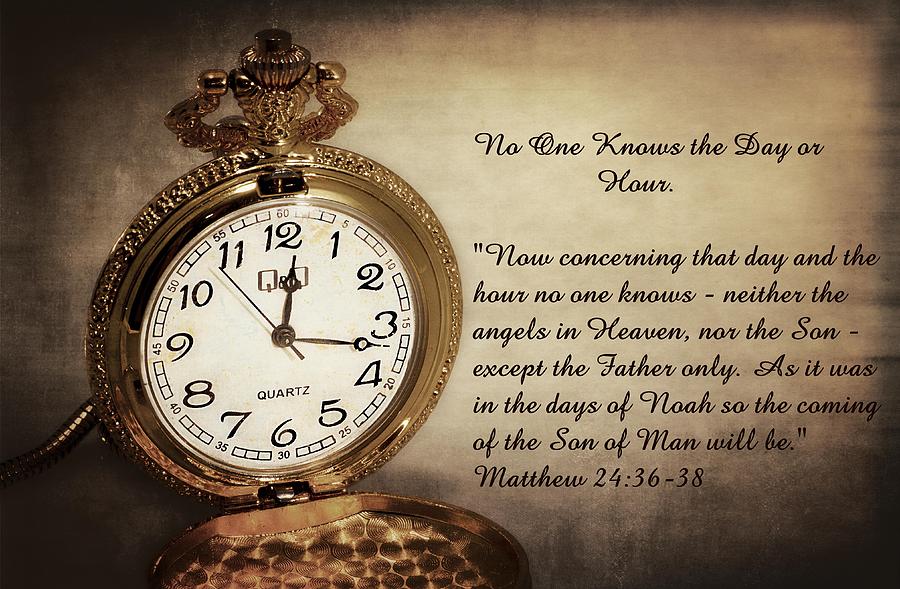
Many Christians use Matthew 24:36 ("No one knows the day or hour") and Acts 1:7 ("It is not for you to know the times or seasons") as a shield for cognitive bias and intellectual shutdown when it comes to date-setting. This article completely dismantles that barrier by examining the original Greek definitions, logically proving the validity of identifying the "specific year" (the outer framework) within God's prophetic schedule.
An Examination of "Day and Hour" in Matthew 24:36
"But of that day and hour knoweth no man, no, not the angels of heaven, but my Father only." —— Matthew 24:36
A close examination of the original Greek words used here makes it clear that this statement does not conceal the "specific year."
・ἡμέρα (hēmera): Means "day," referring to a specific calendar date or a single 24-hour period.
・ὥρα (hōra): Means "hour" or "time," referring to a specific moment, instant, or precise time within a day.
What is highly significant is that Jesus **deliberately chose not to use** the Greek words for "year," such as ἔτος (etos) or ἐνιαυτός (eniautos), nor did He use αἰών (aiōn), which means "age" or "epoch."
Therefore, Matthew 24:36 simply states that the pinpoint moment—the exact month, day, hour, and minute—is hidden. It by no means forbids us from discerning the "specific year" as the outer framework indicated by the 6,000-year timeline of human history.
The Plural Forms of "Times" and "Seasons" in Acts 1:7
And he said unto them, "It is not for you to know the times or the seasons, which the Father hath put in his own power." —— Acts 1:7
In the original Greek text, both "times" (χρόνος • chronos) and "seasons/periods" (καιρός • kairos) are written in the **plural form** (χρόνους / καιρούς). In Greek, these plural forms imply not just a count of time, but "a variety of periods" and "overlapping opportunities."
・Chronos (Plural): Chronological segments or flows of time (months, weeks, or specific ranges of days).
・Kairos (Plural): Divinely appointed critical moments, opportunities, or strategic spiritual interventions within that timeframe.
By intentionally avoiding a singular word for "year" (etos) and choosing these broader terms in the plural, Jesus provided a "divine gradation" (a spectrum of precision) regarding prophetic understanding.
In other words, even when the grand year-level framework of "2028" becomes fully visible, the precise *details*—such as which specific chronos (weeks or days) and which exact kairos (critical moments) the grand drama of the Second Coming will unfold—remain hidden within the Father’s authority. This is the most grammatically accurate interpretation of the text.
The Insight of the Wise Revealed in the End Times
Long ago, Daniel was commanded to seal the prophecy, and the 2,000-year timeline remained hidden from the early Christians.
"And he said, 'Go thy way, Daniel: for the words are closed up and sealed till the time of the end... none of the wicked shall understand; but the wise shall understand.'" —— Daniel 12:9-10
"I have yet many things to say unto you, but ye cannot bear them now. Howbeit when he, the Spirit of truth, is come, he will guide you into all truth..." —— John 16:12-13
As we rapidly approach the culmination of God's master plan—the 6,000 years of human history (paralleling 6 days of labor and 1 day of Sabbath rest)—the Spirit of Truth is opening the eyes of the "wise" to crack the prophetic code.
From God's chronological blueprint, we can discern the grand outer framework of "Autumn 2028" as a logical necessity. Yet, just as Jesus stated, the exact chronos (seasons/days) and kairos (day/hour) contained *within* that year remain beyond human calculation.
"While the exact day and hour (the specific details) remain unknown, discerning the concluding year (the outer framework) is a privilege granted to the children of God."
No matter how distorted the present age becomes, and no matter how much religious organizations trap themselves in repetitive, thoughtless routines, those who remain honest and faithful to the original text will clearly grasp the true intent of this prophecy.


No comments:
Post a Comment